Recent News: Can Too Many CT Scans Cause Cancer?
Dr. Omar Abdihamid unpacks new research linking frequent CT scans to increased cancer risk. He explains the numbers, radiation basics, and common myths—emphasizing that CT scans remain vital in cancer care when used appropriately and sparingly.

Dr Omar Abdihamid
Published on May 4, 2026 • Updated May 4, 2026
Introduction
Have you seen the recent headline by the Journal of the American Medical Association (JAMA)?
CT (Computed Tomography) scans are one of the greatest medical inventions of the last 50 years. Since their debut in the 1970s, CT scans have transformed how doctors diagnose and stage cancer, assess trauma, and guide treatments.
For oncology, CT has been nothing short of revolutionary—allowing precise staging, monitoring treatment response, and planning radiotherapy.
But a new study in JAMA Internal Medicine has raised a concern: could the sheer number of CT scans performed every year quietly be fueling thousands of future cancer cases?
The JAMA Study: By the Numbers
-
In 2023, about 93 million CT scans were performed in the U.S. across 62 million patients.
-
Researchers projected that this could result in approximately 103,000 new cancers over patients’ lifetimes—about 1 in every 20 cancers diagnosed in a year.
-
Abdomen/pelvis scans accounted for the largest share (~37,500 projected cancers).
-
Chest CTs followed (~21,500 projected cancers).
-
Children face higher risk per scan, but most excess cases are projected in older patients due to scan frequency.
Key insight: The risk per scan is small (~0.1% increase in lifetime cancer risk), but across millions of scans, those small risks add up.
Why CT Scans Carry Risk: A Crash Course in Radiation
CT scans use ionizing radiation—a high-energy form of the electromagnetic spectrum that can damage DNA and, over time, potentially trigger cancer.
-
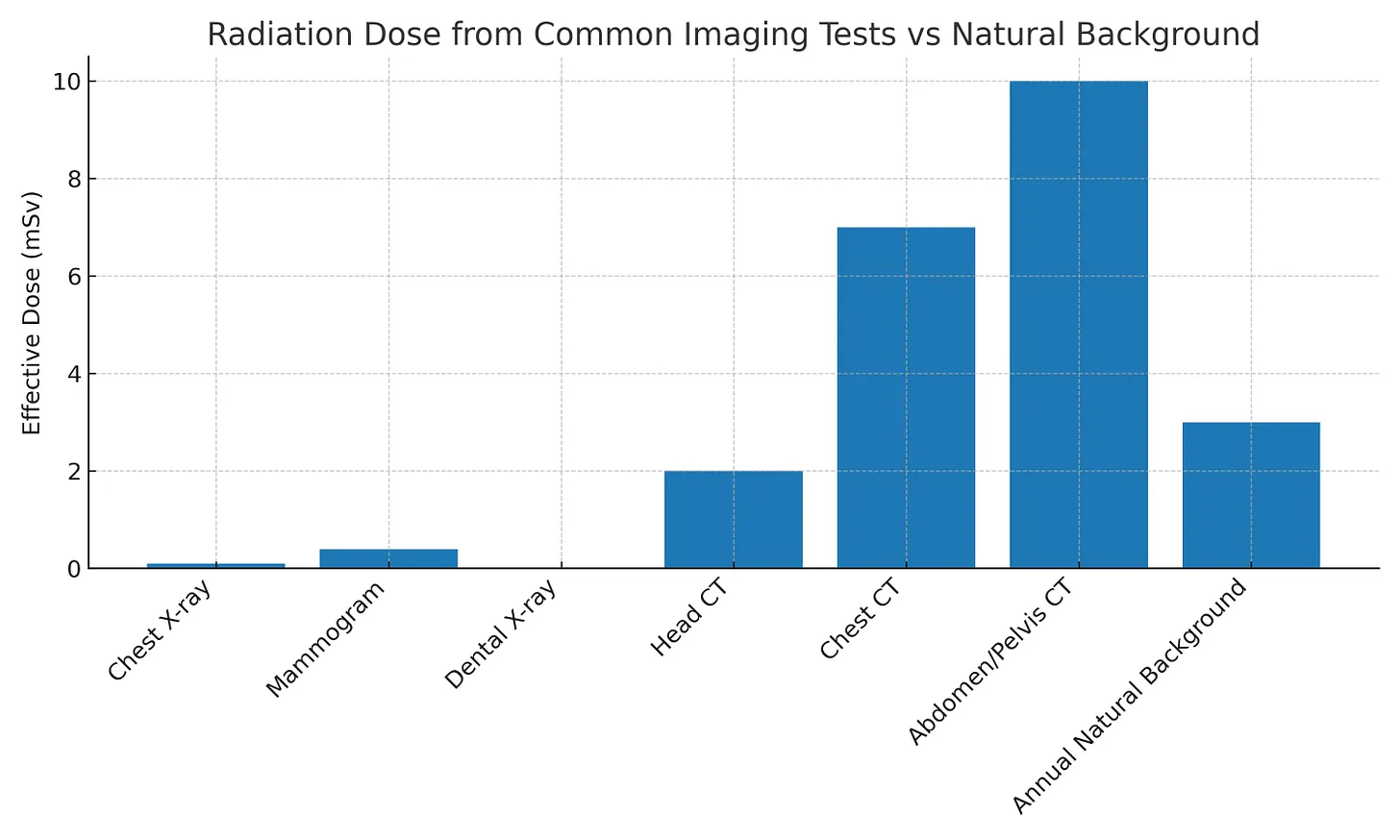
Chest X-ray: ~0.1 mSv of radiation
-
Chest CT: ~7 mSv (70–100 times higher than an X-ray)
-
Natural background radiation: ~3 mSv/year (from cosmic rays, soil, rocks, and radon gas)
This is why CT scans, while safe when used appropriately, are closely monitored with principles like ALARA (“As Low As Reasonably Achievable”).
A Brief History: CT as a Medical Superpower
-
1971: First patient CT scan performed in London.
-
1970s–80s: CT revolutionizes neurology and oncology by offering fast, detailed internal imaging.
-
Today: CT scans are a cornerstone of cancer care—critical for tumor staging, surgical planning, radiotherapy, and monitoring remission or recurrence.
Without CT, modern oncology would feel like navigating in the dark.
Myth vs Fact: CT Scans and Radiation
Myth 1: CT scans are just like light or heat—they can’t harm you.
Fact: CT scans use ionizing radiation, which can damage DNA.
Myth 2: One CT scan will definitely cause cancer.
Fact: The risk is very small (~0.1% per scan). The concern is cumulative risk, not one-off scans.
Myth 3: All radiation exposure is dangerous.
Fact: We all live with natural radiation (3 mSv/year). CT delivers more, but the benefits often outweigh the risks.
Myth 4: More scans mean better care.
Fact: Unnecessary repeat scans add risk. Doctors follow ALARA to balance necessity and safety.
Should You Worry About Your CT Scan?
Not if it’s medically justified. Here’s what matters:
-
Individual risk is low. One scan rarely tips the scales.
-
Cumulative risk matters. Patients with frequent scans, especially cancer survivors, need dose tracking.
-
Alternatives exist. MRI and ultrasound (no radiation) can sometimes replace CT.
-
Doctors already minimize risk. Campaigns like Image Wisely and Image Gently ensure safe, tailored imaging.
Key Takeaway
The JAMA study is not an anti-CT manifesto—it’s a wake-up call. CT scans remain life-saving tools, but unnecessary or repeated scans may plant unintended long-term risks.
-
For patients: Don’t fear your CT scan—but do ask if it’s truly necessary.
-
For health systems: Use CT wisely, track exposure, and avoid repeat scans unless essential.
CT scans should remain what they were meant to be: lifesavers, not liabilities.
About the Author
Dr. Omar Abdihamid is a clinical oncologist and cancer research fellow in Nairobi. He is passionate about cancer awareness, research, and patient education.
📧 Email: [email protected]
📱 WhatsApp: +254 707 024 764